Communication
About Law.
Around People.

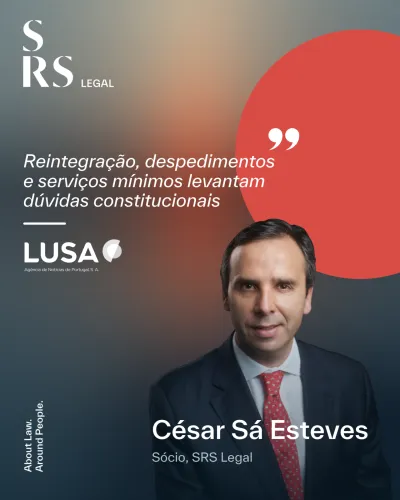
"Reintegration, dismissals and minimum services raise constitutional doubts, say legal experts" (with César Sá Esteves)
«Opposition to the reinstatement of workers, extension of minimum strike services, collective bargaining and simplification of dismissals are the changes in the Government's labour reform that raise doubts about its constitutionality among specialists
in labour law.
César Sá Esteves, Partner at SRS Legal and specialist in labour law and social security, considers that the ‘most controversial’ change in the draft labour reform presented by the Government is the opposition to the reinstatement of unlawfully dismissed workers, as it provides that the employer may ask the court to ‘exclude reinstatement, based on facts and circumstances that make the worker's return seriously detrimental and disruptive to the functioning of the company’, according to the text of the bill.
Although the current law already allows for non-reinstatement in the case of micro-enterprises (up to 9 employees), or when the employee to be reinstated has held a managerial position, extending the measure to all companies, regardless of their size, raises doubts about the constitutionality of the measure.
‘If there is unfair dismissal, the natural consequence should be to “erase” the unlawful act and allow the worker to be reinstated in the company that dismissed them without just cause,’ explains César Sá Esteves to the Lusa news agency, recalling that the Constitution prohibits dismissal without proven cause.
The lawyer points out, however, that when the court finds that a dismissal is unlawful, ‘the worker, in most cases, chooses to receive the compensation plus the wages to which they are entitled, and does not even want to return to the company.’»