Communication
About Law.
Around People.

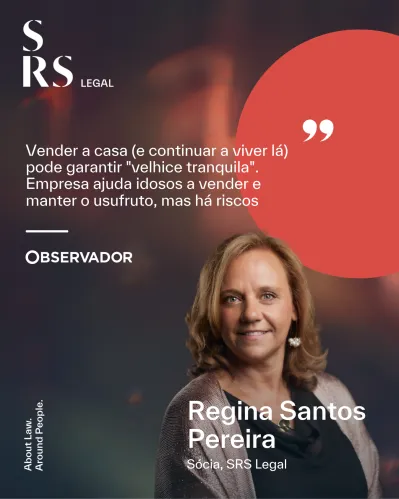
“Selling your home (and continuing to live there) can ensure a ‘peaceful retirement’. A company helps older people sell their homes whilst retaining the right to live there, but there are risks” (with Regina Santos Pereira)
"[...] And this is where one of the key considerations in this transaction lies, according to Regina Santos Pereira, a partner at SRS Legal in the dispute resolution department. “The least risky transaction, from an investor’s perspective, would be to buy a house from someone with no heirs, since, where there are heirs, it is important that they are involved in the transaction because it involves the sale of an asset to which they would be entitled in the future,” explains the lawyer.
The risk is that, upon the owner’s death, one or more heirs may attempt to challenge the transaction by claiming, for example, that at the time of the sale the owner was no longer in full possession of their mental and psychological faculties.
“It is important to make it absolutely clear that the seller was of sound mind and that it can be proven that everything about the transaction was explained to them,” stresses Regina Santos Pereira, pointing out that, in extreme cases, such a situation could lead to the transaction being annulled if the heir manages to prove, for example, that the father or mother was already in the early stages of dementia.
[...]
However, there is a risk that some heirs may challenge that sale, and this must be taken into account, stresses Regina Santos Pereira of SRS Legal. “We are talking about an asset that is being sold and which, as a result, will no longer belong to the children; in other words, the expectation of inheriting the house after the parents’ death ceases to exist,” says the lawyer, noting that “it is important to make it absolutely clear that the seller is of sound mind, that everything has been explained – and with documentation to prove it”.
[...]
In other words, “the risk of a challenge exists provided that the deceased is survived by heirs and provided there are legal grounds to challenge the sale with usufruct, for example, because the sale was made by the deceased without the capacity to do so (a state of severe mental disturbance at the time of the sale); in the event of a fundamental error regarding relevant aspects of the transaction; fraud (deceptive manoeuvres leading to the conclusion of the transaction) or coercion (physical or psychological)”, adds Regina Santos Pereira.